In this article
- What Is Psilocybin?
- María Sabina and the Night That Changed Everything
- From Ceremony to Chemistry: How Psilocybin Got a Name
- The Shutdown, and the Underground That Followed
- The Research Renaissance
- How Psilocybin Actually Works in the Brain
- What the Psilocybin Experience Is Actually Like
- The Real Risks
- Where Psilocybin Fits in the Bigger Picture
In 1955, a Wall Street banker named R. Gordon Wasson traveled to a small village in Oaxaca, Mexico, and spent a night eating dried mushrooms under the guidance of a local healer.
He wasn't a researcher. He wasn't a dropout searching for meaning. He was a senior vice president at J.P. Morgan who also happened to be an amateur mushroom enthusiast. He'd heard rumors about indigenous ceremonies involving psychedelic fungi and wanted to see them for himself.
Two years later, he wrote about it for Life magazine. The article reached 15 million people. And everything that followed, the scientific breakthroughs, the cultural explosion, the political panic, the underground movement, and the research renaissance happening right now, can be traced back to that night in Oaxaca.
This is the story of psilocybin. If you want to understand what all the current excitement is actually about, you need to know this history, not just the chemistry. But we'll get to the chemistry too.
What Is Psilocybin?
Psilocybin is the compound found in certain species of mushrooms that produces psychedelic effects. You've probably heard them called magic mushrooms or shrooms. Over 200 species contain it, found on every continent except Antarctica.
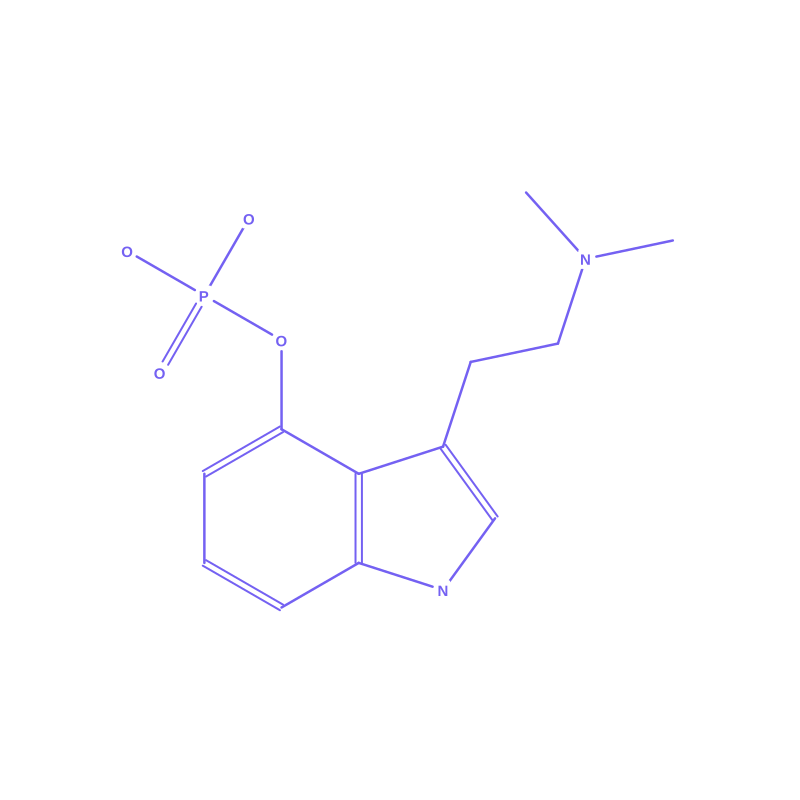
Chemically, it belongs to a family of compounds called tryptamines (which also includes serotonin and melatonin, compounds your brain makes naturally). When you eat mushrooms, enzymes in your gut and liver strip off a phosphate group, converting psilocybin into psilocin. Psilocin is the compound that actually does things to your brain.
Psilocin binds to your brain's serotonin receptors, specifically the 5-HT2A receptor. (Think of it as a lock, and psilocin as the key.) This interaction disrupts your brain's usual communication patterns. Instead of tight, organized networks running on autopilot, your brain becomes more flexible and loose. Activity increases across different brain regions that don't usually talk to each other. Your brain is running looser. Most people just call it a trip.
But chemistry alone doesn't explain why this compound has been part of human experience for thousands of years, or why a banker eating mushrooms in 1955 set off a chain reaction that's still unfolding today.
María Sabina and the Night That Changed Everything
Before Wasson, psilocybin mushrooms were not unknown, they were just unknown to the Western world. The Mazatec people of Oaxaca had been using them in healing ceremonies for generations. The mushrooms were called teonanácatl, roughly "flesh of the gods", and their use was sacred, ritual, and embedded in a specific cultural framework with rules, intentions, and meaning that outsiders didn't have access to.
The healer who guided Wasson that night was named María Sabina. She was a curandera, a traditional healer, and her ceremonies, called veladas, were not entertainment or spiritual tourism. They were medicine. People came to her sick, grieving, lost. The mushrooms were part of the healing work.
Wasson was genuinely moved by the experience. He wrote beautifully about it. And then he published it, with photographs, in one of the most widely read magazines in America.
What happened next was catastrophic.
Word spread fast. Curious Westerners began arriving in Huautla de Jiménez in waves. Tourists, seekers, journalists, eventually counterculture figures looking for the authentic experience they'd read about. The sacred ceremonies became a spectacle. Rituals that had always been private were performed for outsiders who didn't understand, or particularly care, what they were witnessing.
The Mexican authorities noticed the traffic. They came for María Sabina.
She was jailed. Her community, who had always kept the ceremonies private and considered their exposure a serious violation, turned on her. Her home was burned. Members of her family were killed.
She spent the rest of her life largely ostracized from the community she had spent decades serving. Later, she said: "From the moment the foreigners arrived, the 'holy children' lost their purity."
Wasson believed he was contributing to knowledge. He probably was. But the cost was paid entirely by someone else. This is the part of psilocybin's history that gets glossed over in breathless articles about the psychedelic renaissance. The Western discovery of magic mushrooms wasn't a neutral scientific event. It was an extraction, of knowledge, of access, of a tradition, that destroyed the life of the person who made it possible.
From Ceremony to Chemistry: How Psilocybin Got a Name
After his Oaxaca experience, Wasson brought mushroom samples back to Europe. A French botanist identified the species as Psilocybe mexicana and cultivated them in a laboratory. He then sent samples to Albert Hofmann, the Swiss chemist who had famously synthesized LSD, at Sandoz Laboratories in Basel.
Hofmann isolated the active compounds in 1958 and named them psilocybin and psilocin. Sandoz began distributing synthetic psilocybin under the brand name Indocybin to researchers and clinicians. For about a decade, it was a legitimate research subject. Early results showed promise for depression, anxiety, and addiction. The science was young, but the direction was interesting.
Then the 1960s happened, and all of that collapsed.
The Shutdown, and the Underground That Followed
By 1970, the Nixon administration had passed the Controlled Substances Act, classifying psilocybin as Schedule I, defined as having no accepted medical use and a high potential for abuse. The same category as heroin. Research essentially stopped. Clinics closed. Scientists moved on to other things.
Underground use didn't stop. It just became harder and more decentralized.
And here's where the story takes a turn that's become a piece of psychedelic lore worth knowing.
In 1976, a book called Psilocybin: A Magic Mushroom Grower's Guide was published under the pseudonyms O.T. Oss and O.N. Oeric. It was the first genuinely accessible guide to cultivating psilocybin mushrooms at home, detailed enough that anyone with a grow kit and a closet could pull it off. Before this book, obtaining mushrooms meant either finding them in the wild (dangerous, with serious misidentification risks) or knowing the right people.
After the book, you could grow them in a dorm room.
The authors stayed anonymous for years. The book spread through underground networks, quietly making home cultivation a cottage industry.
The true identities of O.T. Oss and O.N. Oeric were later revealed: Terence and Dennis McKenna.
Let that sink in for a second.
Terence McKenna went on to become perhaps the most famous psychedelic voice of the late 20th century. A writer, ethnobotanist, and lecturer whose talks on consciousness, plant medicines, and the nature of mind reached millions. He made the psychedelic conversation intellectually respectable in an era when it was deeply unfashionable. His books and talks are still circulating today.
And before all of that, he anonymously wrote the manual that let anyone in America grow magic mushrooms in their closet.
The same person who handed the underground its toolkit later became the public face of the culture that toolkit helped create. There's something almost too perfectly plotted about that.
Enjoying this? Subscribe free.
Every Tuesday: psychedelic science, policy, and culture, decoded for humans.
You'll also get our free Top 10 Psychedelic Books guide.
You're in! Redirecting to your free guide...
The Research Renaissance
The scientific blackout lasted roughly 30 years. Then, quietly, in the early 2000s, a few researchers decided to start again.
Johns Hopkins University ran tightly controlled psilocybin studies, and the results were striking enough to justify continued work. In 2019, they opened the Center for Psychedelic and Consciousness Research, the first of its kind in the U.S. Imperial College London followed. NYU. UCLA. Major institutions with serious research programs staffed by serious scientists.
The findings that have come out of this work, on treatment-resistant depression, end-of-life anxiety, addiction, PTSD, have been published in journals like JAMA and the New England Journal of Medicine. These aren't fringe publications.
At the policy level, Oregon legalized supervised psilocybin therapy in 2020 (sessions began in 2023). Colorado followed with a broader legalization that also covers several other plant medicines. Multiple cities have decriminalized possession. The FDA has granted psilocybin Breakthrough Therapy designation for treatment-resistant depression, the regulatory fast lane for promising treatments with limited existing options.
This is no longer a fringe conversation. It's mainstream medicine in slow motion.
How Psilocybin Actually Works in the Brain
After you eat mushrooms, psilocybin is converted to psilocin in your gut and liver. Psilocin crosses the blood-brain barrier and binds to serotonin receptors, primarily the 5-HT2A receptor.
The result is a disruption of your brain's default communication patterns. Your "default mode network", the system associated with your sense of self, your inner narrator, the part of your brain that's always running commentary on your life, becomes less dominant. Brain regions that don't normally communicate start talking to each other. The usual boundaries between sensory processing, emotion, and memory become more fluid.
This is why psilocybin experiences so often involve a loosening of the sense of self, unusual connections between thoughts and feelings, and a quality people describe as "seeing things differently", not just visually, but in how patterns and meanings feel.
From a therapeutic standpoint, this flexibility may be the key mechanism. Patterns of thinking that feel rigid and locked, the kind associated with depression, addiction, and trauma, may become temporarily more open to change. Your brain is, briefly, more plastic.
One practical note on the mushroom itself: the cell walls are made of chitin, which humans digest poorly. This is why nausea is common, especially in the first hour. Some people address this by making tea, or grinding dried mushrooms into powder for capsules. Fresh mushrooms have more water weight but the same psilocybin content.
What the Psilocybin Experience Is Actually Like
Here's where any description runs into an immediate problem: these experiences vary enormously. Dose matters. Mindset matters. The environment matters enormously. Two people taking the same amount in the same room can have wildly different experiences.
That said, there are consistent patterns worth knowing.
Set and Setting
"Set" is your internal state, your emotional baseline, your intentions, what you're carrying into the experience. "Setting" is the physical and social environment, who's with you, where you are, whether you feel safe.
Both significantly shape how things unfold. This is part of why the same compound produces such different results in a chaotic recreational context versus a structured therapeutic one. It's not just the psilocybin, it's everything surrounding it.
The Three Phases
Onset (roughly 20-60 minutes in): The first signs are usually subtle. Colors may seem more saturated. Music lands differently. There's sometimes a shift in mood, either a settling, or a mild restlessness that signals something is changing. The world still looks like itself, but attention has a different quality. More curious. More open. More present than usual.
The peak (roughly 1-3 hours in): This is typically the most intense phase. Visual effects, geometric patterns, movement in static objects, halos around light, are common at moderate and higher doses. Time gets strange. Emotions intensify. Thinking becomes more associative than linear. There's often a quality of deep meaning to experiences that in ordinary life would feel mundane. At higher doses, your sense of self can dissolve significantly. That sounds terrifying when described. People very often later describe it as one of the most significant experiences of their lives.
The comedown and afterglow (roughly 4-6 hours total): Perception slowly returns to normal. Most people describe this phase as quiet and reflective, like something has passed and left clarity behind. Some people experience an afterglow that lasts days: better mood, easier access to positive states, a sense of perspective that feels genuinely new. This window seems to be when integration, actually processing what happened and what to do with it, is most productive.
The Real Risks
Psilocybin has a good physiological safety profile. It's not toxic at typical doses, it doesn't cause physical dependence, and deaths from psilocybin alone are essentially unheard of. But the risks are real and worth knowing straight.
Misidentification: This is the most physically dangerous risk for anyone considering foraging. Some deadly mushroom species look similar enough to psychedelic species that even experienced foragers have made fatal mistakes. If you don't have genuine expertise and proper identification tools, don't forage. This isn't overcaution, people have died from this.
Difficult experiences: What's commonly called a "bad trip" is better described as an emotionally overwhelming one. Psilocybin has a way of surfacing things, memories, emotions, fears, that you might have been avoiding. In a safe context with support, this can be valuable. Without preparation or support, it can feel destabilizing in ways that are hard to convey. The evidence suggests difficult experiences aren't inherently harmful, many people later find them meaningful. But "it might matter in retrospect" is cold comfort at hour three.
Psychological vulnerability: People with personal or family history of schizophrenia or bipolar I disorder face higher risks with psychedelics generally. Certain medications, lithium, tramadol, some SSRIs, have known interactions. Anyone with serious psychiatric history should consult a knowledgeable clinician before considering any psychedelic experience.
Dose uncertainty: Unlike pharmaceutical drugs, mushrooms vary in potency. The same visual amount of dried mushrooms can contain very different concentrations depending on species, growing conditions, and storage. Starting lower than you think you need to is genuinely important here, not just cautious language.
Where Psilocybin Fits in the Bigger Picture
Psilocybin is one entry point into a much larger landscape. If you want the overview, how psilocybin relates to LSD, MDMA, DMT, ayahuasca, and mescaline, the full map of psychedelics is wider than any single compound.
This compound specifically sits at a particular intersection: it's ancient and modern at once, legal in some places and a federal felony in others, gentle enough for some contexts and powerful enough to produce experiences people describe as the most significant of their lives. The science is young but increasingly credible. The cultural conversation is louder than it's been in fifty years.
And sitting underneath all of it is the story of a healer in Oaxaca who never asked for any of this, whose tradition was taken, whose life was upended, and whose name is now attached to the moment that set all of this in motion.
That's worth sitting with as the conversation keeps accelerating.
Next up: learn about DMT, the compound that makes psilocybin look like a mild mood booster by comparison.
Related reading
Enjoying this? Subscribe free.
Every Tuesday: psychedelic science, policy, and culture, decoded for humans.
You'll also get our free Top 10 Psychedelic Books guide.
You're in.
Redirecting to your free book guide...