In this article
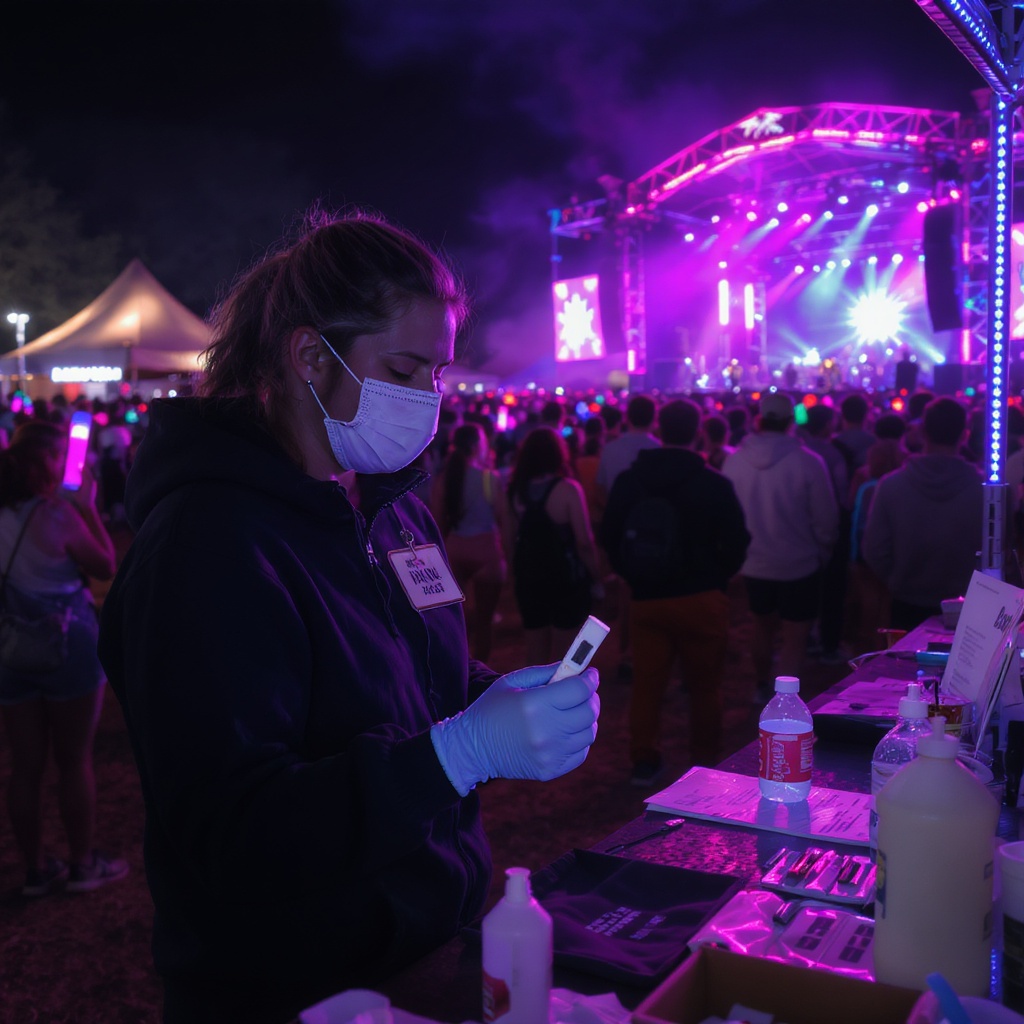
On a warm Saturday afternoon in the Nevada desert, a crowd of 10,000 has gathered for an electronic music festival. In a corner of the grounds, tucked between a medical tent and a food vendor, a small group of volunteers in bright orange vests is quietly changing lives, and saving them.
They are not security guards, not police, not paramedics. They are harm reduction volunteers, and their job is to watch over the people who use drugs at festivals and make sure they survive the experience.
The Death That Changed Everything
The modern harm reduction movement at festivals has a clear origin story. In 2010, at the Electric Daisy Carnival in Los Angeles, 18-year-old Sasha Rodriguez died after ingesting MDMA at the event. Her death was followed by intense media coverage, political backlash, and a wave of crackdowns on festival culture. But inside the community, her death catalyzed something quieter and more durable: a determination to do better.
Organizations like DanceSafe, a nonprofit that provides free drug checking and harm reduction education at festivals, had been doing this work since the late 1990s. But the post-2010 moment accelerated the professionalization and expansion of festival harm reduction programs across the country. What used to be a small group of volunteers handing out pamphlets became a sophisticated operation deploying trained peer counselors, on-site medical staff, and sophisticated drug-checking technology.
Today, groups like the Zendo Project (run by the Multidisciplinary Association for Psychedelic Studies), DanceSafe, and hundreds of local volunteer organizations operate at events ranging from 500-person warehouse shows to 100,000-person festival weekends. Their model has been studied, refined, and, more recently, exported to contexts far beyond the festival gates.
What Harm Reduction Volunteers Actually Do
The most visible part of the job is the peer support tent: a low-stimulation, low-lighting space where festival-goers who are having difficult experiences, a bad trip, an unexpected reaction, a panic attack, can come and be supported by trained volunteers. The space is not medical. It has no IVs, no syringes, no prescription medications. What it has is couches, blankets, calm voices, and time.
The philosophy is based on a simple premise: most psychedelic crises are not medical emergencies. They are psychological experiences that feel dangerous and can be made less dangerous, or more dangerous, by the environment around them. A person who is panicking in a crowd of 20,000 strangers can become a person who processes a difficult experience if you give them a quiet room, a calm presence, and permission to not be okay for a while.
The Zendo Project publishes detailed operational manuals on this approach, drawn from years of data collection at events. Their documentation shows that the vast majority of "crisis" interventions require no medical escalation, they require presence, calm, and time. The peer counselors are trained in something called "grounding" techniques: helping a person reconnect with their immediate physical surroundings when they are spiraling into anxiety or dissociation.
Beyond the peer support tent, harm reduction volunteers work the festival floor with portable drug-checking kits, providing real-time information about what substances actually contain. DanceSafe volunteers use reagent test kits, small chemical reactions that produce color changes indicating the presence or absence of specific compounds. More recently, some organizations have deployed FTIR spectroscopy machines and immunoassay strips capable of detecting fentanyl and other adulterants with significantly greater accuracy than reagent kits alone.
Fentanyl test strips have become a central tool in this work. The opioid epidemic has reshaped the drug supply in ways that affect the festival community as profoundly as it affects anyone else who uses recreational drugs. Powder drugs, MDMA, cocaine, methamphetamine, are increasingly adulterated with fentanyl, sometimes without the user's knowledge. A festival-goer who buys what they believe is MDMA may actually be ingesting a dose of fentanyl that could kill them. Fentanyl test strips allow users to detect the presence of fentanyl before they dose, giving them information that can change their decision.
The strips are not perfect. They produce false negatives in some cases (particularly with novel fentanyl analogues that the strips are not designed to detect), and they do not quantify dose. But they are widely available, cheap (under $2 per strip), and they work. According to research published in the Harm Reduction Journal, people who use fentanyl test strips are more likely to change their behavior, to use less, to use with someone else present, to have naloxone available, even when the test is positive.
The Science of Why This Works
Harm reduction at festivals is not just practical. It is grounded in a body of research on drug-related harm that has accumulated over decades.
Enjoying this? Subscribe free.
Every Tuesday: psychedelic science, policy, and culture, decoded for humans.
You'll also get our free Top 10 Psychedelic Books guide.
You're in! Redirecting to your free guide...
The core insight of harm reduction as a philosophy is that the goal is not to eliminate drug use, that has never worked at scale, but to reduce the harm associated with drug use. This is the same logic that underpins needle exchange programs, supervised injection sites, and naloxone distribution. In each case, the goal is not to enable drug use but to prevent death and disease while acknowledging the reality that drug use exists.
At festivals specifically, the peer support model has been studied. A 2024 study published in Clinical Toxicology analyzed data from 15 festival harm reduction programs and found that trained peer counselors successfully de-escalated the vast majority of psychological crises without requiring medical intervention, and that having trained peers on site significantly reduced the rate of medical emergencies compared to events without such programs.
The drug-checking literature is also clear. A 2023 review of drug-checking programs in North America and Europe found that drug-checking services consistently reduced the prevalence of high-risk adulterants in local drug markets, at least temporarily, because dealers learn that their products will be tested publicly and adjust their behavior accordingly.
The peer education component also matters. Studies on peer-led harm reduction programs show that information delivered by peers, people who share the same cultural context and life experience, is more likely to be trusted and acted on than information delivered by authority figures like medical staff or security. A volunteer who has used MDMA at festivals themselves is more credible to a 22-year-old festival-goer than a medical professional who has not.
The Limits and the Critics
Harm reduction is not universally beloved. There is a persistent critique, both from within the festival community and from law enforcement, that providing harm reduction services amounts to endorsement of drug use, that it makes festivals "safer for drugs" and therefore more dangerous in the long run.
The evidence does not support this critique. A 2019 review by the US Department of Health and Human Services examined the data on festival harm reduction programs and found no evidence that they increase drug use rates. They do not make drug use more appealing, more normalized, or more accessible. What they do is reduce the mortality rate at events where drug use is occurring regardless of what anyone does about it.
What harm reduction programs have not solved, and what remains a genuine tension in the field, is the problem of structural liability and organizational sustainability. Most harm reduction organizations operate on shoestring budgets, relying on volunteers and small grants. They often cannot get insurance coverage. Law enforcement relationships vary wildly depending on local politics and the specific event. In some jurisdictions, providing drug-checking services remains legally ambiguous or explicitly prohibited. This means the coverage is uneven: a large well-funded festival in Colorado or California might have a sophisticated harm reduction program, while the same size event in Texas or Florida might have nothing.
Where This Is Going
The festival harm reduction model is starting to inform a broader harm reduction ecosystem that extends beyond music events. The peer support model, trained non-professionals providing low-barrier emotional support during difficult experiences, has been adopted in some clinical settings for psilocybin therapy trials. Organizations like the Fireside Project have taken the Zendo Project framework and built a phone hotline that people can call during or after a psychedelic experience.
Drug checking technology is also advancing. Spectroscopic methods like FTIR and Raman spectroscopy, which can identify the chemical composition of a sample in minutes without destroying it, are becoming more portable and affordable. Some harm reduction organizations are now operating mobile drug-checking labs at festivals and in urban harm reduction settings. The regulatory environment around these technologies is still evolving, but the trajectory is toward greater accessibility.
The overdose crisis has also pushed harm reduction into more mainstream conversations. Fentanyl test strips are now distributed by health departments in states that would have considered such a thing politically impossible a decade ago. The logic that harm reduction works, that reducing harm is more effective than pretending drugs do not exist, has gained significant ground in public health policy, and the festival community's experience with harm reduction has been part of building that evidence base.
The volunteer in the orange vest at the festival is doing work that did not exist in most people's frame of reference 15 years ago. Today, it is a professional field with training programs, data collection systems, and a body of peer-reviewed research. It is also, in the most direct sense, a way of saying: we know you are here, we know what you are doing, and we want you to survive it.
That is not endorsement. It is pragmatism. And it is saving lives.
For more on how psychedelics work in the body, see our explainer on what psychedelics are. For practical guidance on dosing, see our article on microdosing.
Related reading


Enjoying this? Subscribe free.
Every Tuesday: psychedelic science, policy, and culture, decoded for humans.
You'll also get our free Top 10 Psychedelic Books guide.
You're in.
Redirecting to your free book guide...